|
|
US1881
Hall Latch – High Sensitivity
Download US1881 Datasheet (PDF)
Subscribe To Updates
US1881 General Description
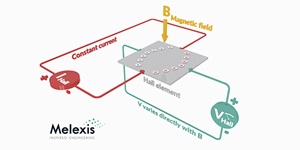
The Melexis US1881 is a Hall-effect latch designed in mixed signal CMOS technology. The device integrates a voltage regulator, Hall sensor with dynamic offset cancellation system, Schmitt trigger and an open-drain output driver, all in a single package.
Thanks to its wide operating voltage range and extended choice of temperature range, it is quite suitable for use in automotive, industrial and consumer applications.
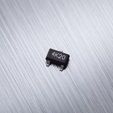
The device is delivered in a Thin Small Outline Transistor (TSOT) for surface mount process and in a Plastic Single In Line (TO-92 flat) for through-hole mount. Both 3-lead packages are RoHS compliant.
US1881 Features and Benefits
- Wide operating voltage range from 3.5V to 24V
- High magnetic sensitivity – Multi-purpose
- CMOS technology
- Chopper-stabilized amplifier stage
- Low current consumption
- Open drain output
- Thin SOT23 3L and flat TO-92 3L both RoHS Compliant packages
- SE package North Pole Active
- UA package South Pole Active
US1881 Environmental Information
This text will be replaced
SEND EVENTS
EDIT PLAYLIST
|
RECEIVED UPDATES
ITEM DATA
|
US1881 Frequently asked Questions
Hall chip weight on plate sensing
Answer
If there is application when you need only two states (on/off) then you can use hall latch like US1881,2881,...
Then you have two possibilityes. You can use permanent magnet and adjust distance betwen hall switch and magnet, or you can made a coil but you need very accurate current source. In this case your distance can be constant and you adjust sensitivity with current!
The first option is cheaper. Current source can be made with a few transistors for second option.
The third option is that you took pre-programmed linear sensor like MLX90215LVA-BC03 (10mV/mT). In this case you must build external hysteresis circuit(one op-amp)and you can adjust it with two resistors(loop)! Here you can also use permanent magnet!
RoHS
Question
Is the Hall Effect US1881KUA RoHS Compliant?
Answer
The plating of the US1881KUA is pure matte tin, so therefor it is ROHS compliant.
More info:
Melexis Lead Free Statement
Melexis Lead Free (Green Packaging) FAQ
rohs compliance
Question
I need RoHS certifiction of Melexis PN US1881LUA
When available?
Honeywell Sensor Cross
Answer
The US1881 - Hall effect latch is the most suitable device to replace the Honeywell.
Here are the characteristics in brief :
- Bop = +5mT typical / Brp = -5mT typical
- Supply Voltage : 3.5V ~ 28V
- Supply Current : 5mA maximum
- Open drain output (Sink)
- Output voltage : 0.5V max
The device is available in several temperature specification. The "L" specification (-40~150deg) is like to Honeywell part.
The packages proposed offer possibility for through-hole (UA package) or surface mount (SE package).
The main difference is regarding the packaging as we do not deliver the same package as Honeywell.
Please refer to the datasheet on our website for more detailled technical information.
US1881
Question
I want to apply the us1881 with the 60 magnet poles and 30 thousands circles per minute.I calculte the frequency is 30K Hz.May us1881 be used in the condition?
Question
The US1881 maximal switching frequency is determined by the response delay between triggering the Hall sensor above a magnetic threshold (Bop or Brp) and having the correct change on the output.
In such condition, the maximal switching frequency is 10KHz typically. It means that the US1881 is able to detect and give the correct output state in a magnetic field switching up to 10KHz typically.
The absolute maximal limit of the switching frequency is expected to be around 15KHz.
Hence, in the condition you mention with a magnetic field switching frequency at 30KHz, it is not possible to use the US1881.
However, according to your condition, I understand the rotor is composed of 60 different poles, so 30 north and 30 south poles. To calculate the magnetic field frequency, the following formula shoud be used :
Ffield = ( RPM * N ) / 60
Where:
Ffield is the frequency at the output (so the magnetic field frequency as well)
RPM is the rotation speed
N is the number of pole pairs
60 different magnetic poles means 30 pole-pairs.
In case the motor rotates at 30000 RPM, the magnetic field frequency would be 30000 * 30 / 60 = 15kHz.
In such condition, it might work but it is close to the upper limit so it would be advised to reduce the number of magnetic poles to reach 10kHz switching magnetic field.
By reversing the above formula, we can conclude that a rotor composed by 20 pole-pairs is safer.
Question
Pls help me solve a question:How much hz is the us1881 switch frequency.The clear answer can't be found in the datasheet.
One another question,Do you have the hall element adapting to the 100KHz frequency application?
Answer
As you have surmised correctly this is not an appropriate use for this IC. The current in a PCB trace is generally much too small and generates a very weak magnetic field. Usually the field is orders of magnitude smaller than the field required to switch an 1881 Hall Latch. Even our linear Hall ICs, like the MLX90215 or MLX90251 are not sensitive enough for this task. Melexis has a device called the CSA1V that can be used to detect certain currents flowing in a PCB trace. You can learn more about this part at http://www.sentron.ch/csa.htm. Sentron is a Melexis company that specialies in advanced magnetic sensor technologies.
To make the US1881 work would require a toroidal ferrite core with the 1881 inserted into an air gap in the core and then likely several hundred turns of copper magnet wire on the core. The current would then be run through this coil and the field in the gap would be a multiple of the amp turns of the windings. I am sure this is not what you had in mind so look at the CSA1V and see if it could meet your expectations. This IC uses very clever on chip flux concentrator technology to give a more sensitive detection solution without requiring ferrite cores and windings.
|
|