|
|
MLX90247
Infrared Sensor IC
Download MLX90247 Datasheet (PDF)
Subscribe To Updates
MLX90247 General Description
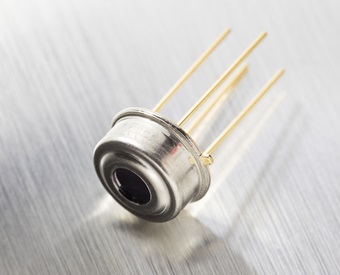
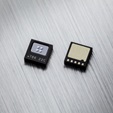
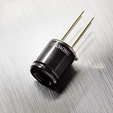
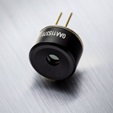
The MLX90247 family sensors are thermopile sensors detecting very small amounts of heat radiation. The sensors consist of a membrane with a thermopile on top of it. The hot junctions of the thermopile are positioned near the center of the membrane and the cold junctions above the bulk silicon edge. Due to the low thermal conductivity of the membrane, absorbed heat will cause the temperature of the membrane to increase above the temperature of the surrounding bulk silicon. This temperature difference is converted into an electric potential by the thermo-electric effect in the thermopile junctions. No supply voltage is needed. The MLX90247 can be used to detect thermal radiation from a distance and to detect fast changes in temperature and heat. The output signal is an analog voltage that is uncalibrated. This part is no longer supported by Melexis.
To make a non contact IR thermometer the MLX90614 should be used as this thermometer -while looking exactly like the MLX90247- generates a linearized and calibrated temperature reading.
MLX90247 Features and Benefits
- Solid state sensor
- High reliability
- Low cost
- small size
- On chip temperature sensor
MLX90247 Environmental Information
This text will be replaced
MLX90247 Frequently asked Questions
90247 Detection Wavelength
Answer
The 90247's detection wavelength is mentioned on page 3 of the MLX90247 datasheet, in the specifications table, under the title "spectral sensitivity". The spectral sensitivity is higher than 70% in the wavelength range 7.5 to 13.5 micrometer. The long-wavelength pass filter of the component blocks all radiation having a wavelength below 5 micrometer (spectral sensitivity below 1%). The datasheet can be downloaded on www.melexis.com.
Lense for MLX90247B
Question
Can you recommend a lense to use in front of my MLX90247B? The specs provided are fine, I just need something that will mechanically seal the device.
MLX90247 RoHS Status
Answer
Melexis confirms that the MLX90247thermopile devices, the MLX90614 and MLX90615 infrared thermometer sensor family and the EVB90614 and EVB90615 are RoHS compliant.
MLX90247B
Answer
As indicated in the datasheet of the MLX90247 thermopile, the sensitivity is typically 34 microVolt/°C for the version with window of 2.5 mm diameter, and typically 46 microVolt/°C for the version with window of 3.5 mm diameter.
The thermopile has a resistance of 60kOhm. This resistance is the main noise-contributor (thermal noise): 32 nV/square root (Hz). The total noise depends of course on the bandwidth of the circuit used to read out the thermopile, and this total noise determines the resolution of the temperature reading.
MLX 90247
Question
I am interested in using the MLX90247 thermopile to measure temperatures of 1500 - 2000 C. Basically I would like to measure temperature of molten steel. Is this possible?
Answer
The standard MLX90247 would not work in the high temp region1500 - 2000 °C because of the wavelength which is used.
Question
I'm interested in knowing more about the Field Of View (FOV) of the MLX90247:
-What are the measuring conditions?: For example, the distance from the radiation source, the temperature of this one,...
- Are the degrees related with the rotation in one plane of the thermopile? (with respect to the direct sight to the radiation source).
-With an angle of 100 degrees the thermopile still receives the 90% of the energy (the energy received at 0 degrees, I supose), how is this posible? I supposed that with 90 degrees, the thermopile will not receive any energy.
Answer
Use of MLX90247 for ear thermometers regarding safety for the users:
The MLX90247 is a low-tension low-power device.
A certificate of suitability of use for medical purposes should however be obtained at the level of the ear-thermometer, by the manufacturer of the ear-thermometer.
Answer
Digikey:
I reviewed the information on the Digikey site, and I am taking action to bring it up to date.
In fact, the MLX90247 B on the Digikey site corresponds to the MLX90247ESF-DSA in the datasheet.
The MLX90247 C on the Digikey site is no longer supported. It does not correspond to any of the 4 component types mentioned in the current datasheet.
Thank you for letting me know that the information on the Digikey site is confusing, and sorry for the inconvenience.
Answer
the MLX90247 has a cut-on wavelength of 5.5 micrometer.
Above a few 100 degree Celsius, most of the energy radiated by the object has shorter wavelength than 5.5 micrometer and does not reach the thermopile sensor. So, the standard MLX90247 is unfortunately not useable for temperatures in the order of 1500 to 2000 °C.
Question
Yes, MLX90247 consists of IR thermopile sensor and a PTC RTD element. The TO39 package has high thermal conductivity, so heat transfer through the pins might result in sensor die temperature different from the ambient, and therefore some care should be taken to ensure the heat transfer is to ambient and not PCB or wires, for example. As a typical PTC, the sensor transfer function is R(t) = R0.{ 1 + (t-t0).TC1 + [(t-t0)^2].TC2 }, and the TC1 and 2 are defined for t0=25deg.C. Sensor itself is not provided calibrated, so the 3 values R0, TC1 and TC2 will vary from sensor to sensor and calibration will be needed.
As the sensor package is hermetically sealed neither moisture nor wind will affect the sensor itself. However, external leakages (between the pins/wires/solder pads/PCB traces...) are not covered by that sealing and therefore moisture (especially condensing) would require their prevention. Leakage that results in 10 MOhm shunt to the PTC RTD connections may result in up to 1deg.C error in some cases.
As a matter of fact, wind is most likely to improve measurements accuracy as far as it improves the thermal contact (convection) between the sensor and the ambient (assuming the air temperature is of interest).
MLX90247 Output Voltage
Question
I have a MLX90247 thermopile and I am having some trouble getting a usable reading from it. When the output is connected to an oscilloscope, all I see is noise centered on ground, with a magnitude of about 5mV. The data sheet states that the output should be approximately 40uV/K. That should translate to about 11.8mV for room temperature. When I hook this thermopile up to a non-inverting amplifier, I see the thermopile output change to 400mV. I cannot explain why that is happening. Can someone please describe a basic circuit that can amplify this signal to a usable range (0-3.3V).
Answer
A thermopile sensor measures the temperature difference between its own temperature and the object it is looking at through the window. If the sensor has a temperature of 20C and the object a temperature of 40C, the output will be approximately 800uV.
A basic schematic to amplify the thermoplie signal can be found at the bottom of page 6 of the MLX90247 datasheet.
A digital solution which also makes it possible to measure the resistance of the integrated thermistor can be found at:
EDN issue 2003, April 3
http://www.edn.com/article/CA286247.html?spacedesc=designideas&industryid=44217
Please note: to have an accurate temperature measurement, both the thermopile output and thermistor must be calibrated, which is not a simple task.
Reducing the MLX90247(DSA Type) FOV
Question
Now how can I reduce the MLX90247 FOV? and where can I purchase such part which adjust its FOV?
Answer
Making a thermometer with a +/-1 degree accuracy with the MLX90247 will be very difficult, certainly for small FOVs. I advise not to use this component. We do have calibrated IR thermometers. This is the better choice for your challenge.
MLX 90247 readings
Question
I am now using the MLX90247 to measure surface temperature. The readings seem to be accurate at low temperatures; but at higher temperatures, such 100+ degrees F, its readings are off by 20-30 degrees F. Does this mean that the sensor needs calibration? and does emissivity of the object being measured also affects the sensor readings? If so, how can I compensate for low emissivity values?
Answer
The MLX90247 is a thermopile sensor giving a voltage output depending on the temperature of the object it sees. However, this is a purely analog device without any internal calibration. If you are making a thermometer, you will have to calibrate the setup (MLX90247 + electronics) you made yourself.
Our new MLX90614 on the other hand is a smart sensor with integrated electronics and comes factory calibrated.
Emissivity of the object does influence the sensor reading, but in general this is only an issue for metals which have a low emissivity. Compensation for low emissivity can be done through calculation if you know the emissivity of the surface you are measuring.
MLX90614 vs MLX90247
Question
I need to measure the temperature of an object accurately to within 0.3C from 0C to 40C. The 90614 can not quite do that. My question is then is it possible to obtain that accuracy by performing a two point calibration of the MLX90247 as part of a system. The difference between ambient and object temperature will be between 0C-25C.
Buy MLX90247
|
|