
Rethinking Seat Track Position Detection: From Mechanical Switching to Intelligent Automotive Sensing
By Zlatko Stoyanov, Applications Engineer at Melexis
Today’s automotive innovation is often framed around electrification and autonomy. However, an equally significant transformation is taking place within vehicle body electronics, particularly in how physical states are detected, interpreted, and acted upon.
This shift is clearly visible in seat track position detection, an application that has evolved from a simple convenience feature into a critical safety function. By determining the seat’s position relative to the steering wheel, the airbag control unit (ACU) can adjust deployment behavior, ensuring both effective protection and reduced injury risk across different occupant profiles.
What was once a simple forward or rearward detection problem has become a multi-position sensing challenge, directly tied to safety, system behavior, and user experience.
As vehicles continue to evolve toward software-defined architectures, the ability to accurately detect and communicate physical states is becoming foundational. The challenge for engineers is no longer simply how to sense position, but how to do so in a way that scales within existing system constraints.
Traditional Seat Track Detection: Increasing Resolution, Increasing Complexity
To understand why this shift is occurring, it is important to look at how seat track detection is implemented today.
The automotive industry has followed a clear and logical path in seat track position detection, and as safety requirements have evolved, so too has the need for greater positional resolution. However, each step forward has introduced new integration challenges, particularly as systems attempt to scale within the constraints of established electrical architectures.
Most seat position sensing systems are built around a two-wire current interface, a long-established industry standard that allows both power and signal transmission over the same connection. In its simplest form, this approach uses fixed current levels to represent position. A single sensor can indicate whether a seat is forward or rearward by outputting approximately 6 mA or 14.5 mA, with the ECU interpreting these signals within predefined tolerance ranges, typically spanning 5 to 7 mA and 12 to 17 mA, respectively.
| State | Position | Output current | Range |
|---|---|---|---|
| Ioff | Rearward position | 6 mA | 5 mA - 7 mA |
| Ion | Forward position | 14.5 mA | 12 mA - 17 mA |
This binary approach has proven to be simple, cost-effective, and robust. However, it provides only limited positional insight, which is no longer sufficient for modern safety and system requirements.
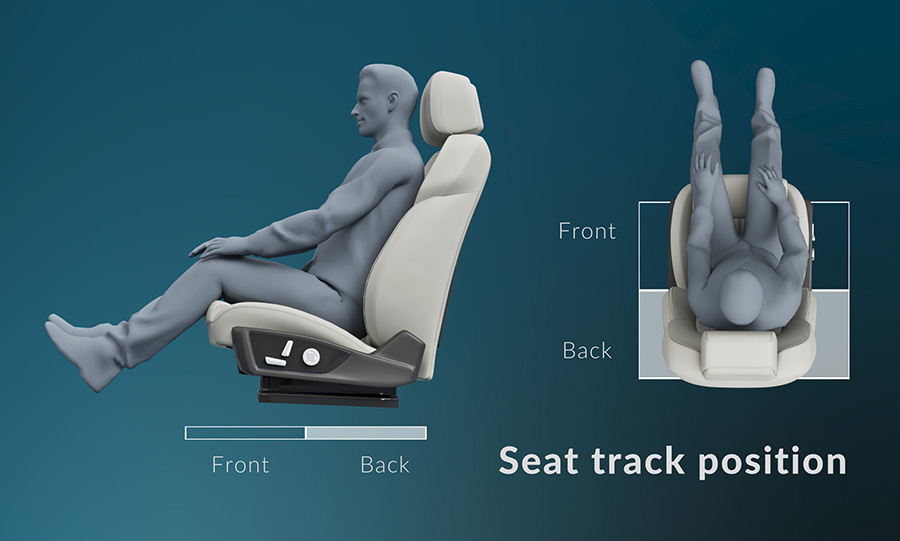
Extending Detection Without Changing the Interface
To introduce additional positional states, OEMs have traditionally extended this approach rather than replacing it. A common method is to combine two sensors on the same two-wire interface, allowing multiple zones to be inferred by summing their output currents.
In principle, this enables greater resolution without altering the underlying interface. In practice, however, it introduces a set of challenges that become increasingly difficult to manage as system requirements evolve.
Because each sensor operates within relatively wide tolerance bands, combining their outputs inevitably leads to overlapping current ranges. The upper boundary of one state can encroach upon the lower boundary of another, reducing the separation between zones and making reliable interpretation more difficult, particularly under real-world operating conditions.
| Zone | Sensor A state | Sensor B state | ECU target range* | Achieved Range (Stack-Up) |
|---|---|---|---|---|
| Zone 1 | Off (6 mA) | Off (6 mA) | 5 mA – 7 mA | 10 mA – 14 mA |
| Zone 2 | On (14.5 mA) | Off (6 mA) | 12 mA – 17 mA | 17 mA – 24 mA |
| Zone 3 | On (14.5 mA) | On (14.5 mA) | 21 mA – 26 mA | 24 mA – 34 mA |
* Example values only. Actual integration ranges may vary.
This comparison highlights a fundamental issue, that the achieved current ranges no longer align cleanly with the standardized ECU input windows. In particular, the upper limit of Zone 2 and the lower limit of Zone 3 converge around 24 mA, creating ambiguity between adjacent states.
This lack of separation becomes especially problematic in fault scenarios. If one sensor fails or degrades, the combined signal may still fall within what appears to be a valid window. From the ECU’s perspective, the system remains in a plausible state, masking the fault and creating a diagnostic blind spot.
This raises a critical question: is the detected signal a valid position, or the result of a partial fault within the sensing or wiring system? In conventional dual-sensor architectures, the ECU cannot reliably distinguish between the two.
Simultaneously, stacking current levels can push the combined signal beyond the input ranges expected by the ECU, which are typically constrained to around 30 mA. These interfaces are deeply embedded within vehicle architectures and are rarely modified once deployed, as doing so would require extensive hardware and software revalidation across multiple vehicle platforms.
Beyond signal interpretation, this approach also introduces broader system-level inefficiencies. The use of multiple sensors increases component count, wiring complexity, and integration effort, often requiring parallel connections or custom implementations that are difficult to standardize across platforms.
As a result, what begins as a logical extension of existing sensing principles can evolve into a form of custom solution that is difficult to scale, replicate, or migrate between vehicle programs.
Rethinking Automotive Position Detection: The Case of Seat Position
To understand how these challenges are being addressed, it is useful to return to seat position detection as a representative application.
In modern implementations, increasing the number of detectable positions has traditionally required adding more sensors and combining their outputs. However, this approach struggles to meet emerging requirements for safety, integration, and system efficiency. Addressing these challenges requires a shift toward sensing architectures that can deliver multiple states without increasing system complexity.
A Single-Sensor Approach to Multi-Position Detection
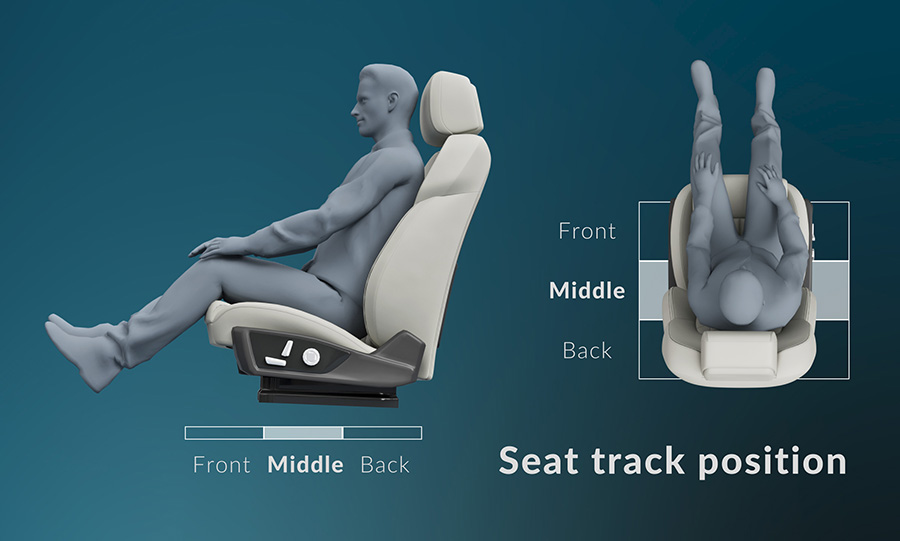
Building on decades of experience in automotive magnetic sensing, Melexis has developed the MLX92344 to address the limitations of conventional dual-sensor seat track architectures, introducing an industry-first approach to programmable multi-position detection within a single device.
At its core, the device replaces the multi-sensor approach with a single monolithic sensor IC, capable of detecting perpendicular or lateral magnetic fields and translating them into multiple discrete output states over a standard two-wire interface. Instead of relying on the summation of multiple signals with wide tolerances, the MLX92344 delivers a single, high-accuracy, multi-level output. This ensures clear separation between states and eliminates the overlap issues inherent in current stacking approaches.
This capability is enabled through a combination of programmable output behavior and precise magnetic thresholding. The device allows designers to define output currents across a range of approximately 3 mA to 28 mA, rather than being limited to fixed levels. With excellent performance and tight tolerances, these outputs can be aligned precisely with ECU input windows, ensuring reliable interpretation under all operating conditions. This difference becomes particularly clear when comparing a three-zone implementation using a single MLX92344 device with the equivalent dual-sensor approach.
| Zone | MLX92344 state | ECU Target range* | Achieved Range |
|---|---|---|---|
| Zone 1 | LOW: 6 mA | 5 mA - 7 mA | 5.4 mA - 6.6 mA |
| Zone 2 | HIGH: 14.5 mA | 12 mA - 17 mA | 13.45 mA - 15.55 mA |
| Zone 3 | MAX: 23.5 mA | 21 mA - 26 mA | 22 mA - 25 mA |
* Example values only. Actual integration ranges may vary.
Unlike stacked sensor configurations, the achieved ranges remain fully contained within the expected ECU input windows, with clear separation between each state. In practice, this enables three- or four-position detection using a single sensor, replacing what would traditionally require multiple discrete components. Furthermore, fast signal response ensures that both magnetic state changes and diagnostic conditions are communicated within tight system timing requirements.
Architectural Freedom and Seamless Integration
A key requirement in automotive system design is the ability to introduce new functionality without disrupting established architectures. The MLX92344 has been designed explicitly with this constraint in mind. By allowing output current levels to be programmed within existing interface ranges, the device can be integrated without requiring any changes to ECU hardware or software. This enables a straightforward adoption path while avoiding the cost and complexity typically associated with introducing new sensing behavior.
Crucially, this programmable flexibility grants OEMs and Tier-1 suppliers the ultimate freedom to customize the sensor interface to match their evolving next-generation architectures based on their specific needs.
Moreover, consolidating multiple sensing functions into a single device reduces component count, simplifies wiring, enables more compact implementations, and improves overall system robustness. This architectural simplification also improves diagnostic clarity. Developed as a Safety Element out of Context (SEooC) in accordance with ISO 26262, the MLX92344 includes integrated self-diagnostics and a defined safe-state output. In the event of a fault, the device transitions to a dedicated current level, ensuring that fault conditions can be clearly identified by the ECU without ambiguity.
In seat track systems, this enables reliable multi-position detection within a single compact sensor, supporting increasingly demanding safety requirements without increasing system complexity. More broadly, the same approach can be applied across a range of body electronics applications, including latching systems, charge ports, and gear selectors, where multi-state detection must be achieved within tightly constrained designs.
Conclusion: Sensing as a Foundational Design Decision
As vehicles continue to evolve toward more adaptive, safety-aware, and software-defined systems, the importance of accurately detecting and interpreting physical states is becoming increasingly central to overall system performance.
What may appear to be a relatively simple function is now directly linked to safety outcomes, system behavior, and user experience. As demonstrated through seat position detection, increasing functional demands cannot be met by simply adding more components, but require a more fundamental shift in how sensing is approached.
This reflects a broader realization within the industry: sensing is no longer a passive input, but an active enabler of system design.
By combining contactless sensing, programmability, and integrated diagnostics, solutions such as the MLX92344 demonstrate how this evolution can be addressed in practice. Rather than scaling complexity alongside functionality, they enable system designers to meet increasing requirements while maintaining control over integration, reliability, and cost, reinforcing the idea that even seemingly simple sensing functions now play a defining role in overall vehicle system performance.
