
Why Modern Vehicle Safety Demands Smarter Seat Belt Buckle Sensors
By Petar Emilov Paunov, Applications Engineer at Melexis
As vehicles become more digitized, the demands placed on automotive body electronics reach down to the detection of basic physical states. Reporting whether a mechanism is open or closed may seem straightforward, but the signal must remain dependable throughout the vehicle’s lifetime, conform to a defined electrical interface and support the system’s functional safety requirements.

Seat belt buckle switches (SBBS) illustrate the challenge. Many use a simple two-wire connection through which power and the status signal share the same electrical path. This established architecture reduces wiring complexity and cost but leaves little scope to communicate additional information or distinguish faults from valid operating states. As vehicle architectures evolve towards software-defined vehicles (SDVs), designers must accommodate greater sensing and diagnostic capability within these existing interface constraints.
The buckle signal also has consequences beyond a seat belt reminder. When used by restraint-system logic, it becomes an input to a safety-relevant decision, making predictable behavior and recognizable fault conditions essential. Meeting those requirements calls for closer consideration of how the sensor works with the wider system. For Melexis, that means combining reliable state detection with integrated diagnostics and the flexibility to accommodate different buckle designs.
Defining Buckle States Within a Two-Wire Interface
Mechanical switches and basic Hall-effect sensors have long been used to detect whether a seat belt is fastened. In a current-mode Hall implementation, the electronic control unit (ECU) reads the buckle state from the current drawn by the sensor. With the same two-wire connection supplying power, reliable detection depends on keeping each output level within the ECU’s designated input window.
Three current conditions allow the interface to communicate buckle status and indicate a fault.
- Unbuckled is indicated by a programmable low current, typically within either 2 to 5 mA or 5 to 6.9 mA, depending on the ECU input thresholds.
- Buckled corresponds to a higher current, typically between 12 and 15 mA.
- Safe state uses a current below 1 mA to identify a fault condition, such as an internal failure or certain wiring faults.
The separation between these levels must hold across changes in temperature and supply voltage, as well as component tolerances. If a valid output moves outside its expected window, the ECU may no longer interpret the buckle state correctly. Diagnostic behavior must therefore be considered alongside the accuracy and stability of the normal operating currents.
Although this interface provides a practical basis for status detection and wiring diagnostics, the sensor determines how much flexibility it offers. Basic devices can have fixed switching characteristics and limited internal fault monitoring, leaving designers less scope to accommodate different ECU requirements or identify failures within the sensing element.
This distinction matters when the buckle signal feeds restraint-system logic, as an ECU needs an unambiguous indication of whether the belt is fastened, together with a recognizable fault state when the sensor cannot provide a valid result. Achieving this electrically is only part of the task, however, because the sensor must also work within the physical constraints of the buckle assembly.
Working Within the Buckle Assembly
Delivering this performance within a seat belt buckle introduces several application-specific constraints. From an integration perspective, manufacturers often require two-wire, PCB-less designs to reduce wiring complexity and simplify assembly while keeping costs down. Removing external components, including discrete capacitors, places further demands on the sensor, which must incorporate more of the functionality needed for reliable operation.
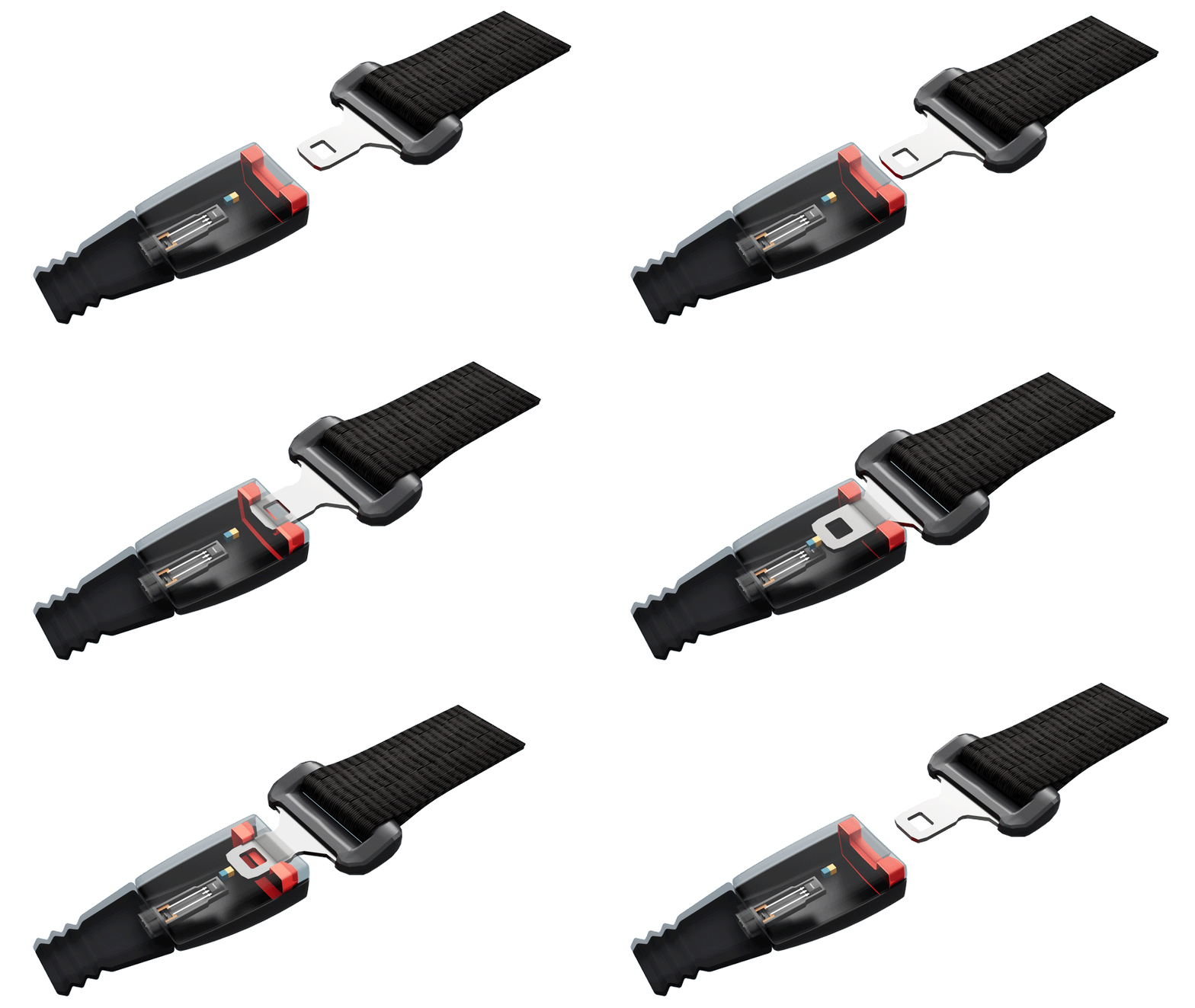
The electrical environment adds another constraint. A buckle sensor typically connects directly to the vehicle battery, while its position within reach of the occupant exposes it to electrostatic discharge (ESD). The device therefore needs sufficient electrical robustness to withstand these conditions, particularly where grounding options are limited.
Mechanical variation can be just as challenging, as the position of the magnet relative to the sensor depends on the buckle mechanism and its assembly tolerances. Differences in that air gap change the magnetic field reaching the sensing element, so thresholds that work in one assembly may not produce the same switching behavior in another. Accommodating this variation can require stronger magnets, such as samarium-cobalt (SmCo) or neodymium-iron-boron (NdFeB), or repeated adjustments to the magnetic and mechanical design.
Package selection and sensing orientation also shape the system design. Although PCB-less assemblies are often preferred, some OEMs use surface-mount device (SMD) implementations when they need greater design flexibility.
Z-axis sensing remains the conventional choice, detecting a magnetic field perpendicular to the sensor surface with the magnet generally located above or below the device. However, increased use of lateral (X-axis) sensing gives engineers more scope to develop compact buckle mechanisms. Sensitivity to fields parallel to the sensor surface allows the magnet to be positioned and moved alongside the device, reducing the need for vertical stacking. This opens up alternative mechanical arrangements, while placing greater demands on sensor sensitivity and the design of the magnetic system.
For Tier 1 suppliers and automotive OEMs, buckle sensing therefore requires a balance between a defined electrical interface and the realities of the installation. The sensor must tolerate electrical stress and mechanical variation while maintaining clearly distinguishable buckle states and dependable fault indication for safety-relevant vehicle functions.
Meeting Buckle Design Requirements with Melexis
In a seat belt buckle system, a binary signal can influence how the vehicle’s restraint systems respond. Clearly distinguishing between buckle states, and recognizing when that information cannot be trusted, is therefore central to reliable operation.
Melexis has developed a family of programmable current-mode Hall-effect switches to meet these safety-relevant signaling requirements within a two-wire architecture. The MLX92341 provides the foundation, combining dependable state detection and compatibility with ECU input windows with integrated diagnostics and electrical robustness. Building on these capabilities, the MLX92342 adds end-of-line programmability, allowing manufacturers to compensate for mechanical tolerances once the sensor is installed in the buckle and achieve consistent switching behavior across production.
Combining Robustness with Simpler Integration
To support safety-critical operation, both devices include internal self-diagnostic functions that continuously monitor sensor behavior. Developed according to ISO 26262 as ASIL B Safety Elements out of Context (SEooC), they provide a dedicated safe-state output below 1 mA when a fault is detected. This gives the ECU a clearly distinguishable fault indication, with output updates within 100 µs supporting timely communication of diagnostic conditions.
The MLX92341 and MLX92342 also provide high ESD robustness for applications exposed to direct battery connection and occupant contact. This helps protect the sensing element against electrical stress during assembly and throughout the vehicle’s operating life.
To simplify integration within the buckle assembly, Melexis incorporates the capacitor within the molded sensor package. This allows the two-wire device to connect directly to the wiring harness in PCB-less implementations, reducing component count and assembly work while supporting compact designs without compromising electromagnetic compatibility (EMC) or ESD performance.
Accommodating Mechanical Variation and Expanding Design Options
Building on these shared capabilities, the MLX92342 adds end-of-line programmability to address mechanical variation within the buckle assembly. Manufacturers can program the magnetic thresholds at which the sensor switches between buckle states after installation, allowing them to calibrate the operating and release thresholds to the actual magnet-to-sensor relationship in each assembly.
This helps maintain consistent switching behavior across production, reducing the need for tighter mechanical tolerances or higher-cost magnets. It also gives designers greater scope to resolve magnetic variation through calibration, helping reduce repeated changes to the buckle design.
High magnetic sensitivity and accuracy, together with programmable temperature compensation, provide further flexibility in magnet selection. Configurable output current levels allow the electrical response to be matched to the ECU, helping Tier 1 suppliers and OEMs adapt the sensing solution to different buckle designs and vehicle requirements.
Extending Sensing and Control Across the Seat
The same need for clearly defined signals within established interfaces extends beyond the buckle. Seat position, for example, helps the airbag control unit determine how to adapt deployment to the occupant’s distance from the steering wheel, while position feedback also supports motorized adjustment to driver preferences. For restraint-system applications, Melexis applies its programmable current-mode sensing approach through the MLX92344, enabling three- or four-position detection with a single device over a two-wire connection. Rather than summing the currents from multiple sensors, it assigns distinct output levels to each position, maintaining separation within the ECU input windows and providing a dedicated safe state for fault detection.
Elsewhere in the seat, the engineering task shifts from detecting position to controlling movement and airflow. Melexis’s embedded motor-driver ICs support motorized seat adjustment, working with Hall-effect sensors that provide feedback on motor movement. Fan and pump driver ICs address ventilation, controlling the fans that move air through the seat to improve occupant comfort. Across these applications, integrated control functions and communication interfaces help manufacturers incorporate motor control and diagnostic feedback within the vehicle architecture while limiting the external circuitry required in the seat assembly.
Building Reliable Inputs for More Capable Vehicle Systems
Across the seat, the demands placed on sensing and control have moved beyond the capabilities of a basic status switch. Detecting a physical state is only the starting point. The signal must fit the vehicle’s electrical architecture, remain dependable through operating variations and make faults visible to the systems using it. These requirements make sensing an integral part of system design, with consequences that extend from the buckle assembly to restraint-system behavior.
The MLX92341 and MLX92342 address this through programmable current levels and embedded diagnostics within robust, highly integrated devices. The MLX92342 adds end-of-line calibration, allowing manufacturers to accommodate mechanical variation while maintaining predictable switching behavior. Across its seat-sensing and motor-control portfolio, Melexis helps engineers introduce greater functionality while managing component count and integration complexity.
As vehicles evolve towards more software-defined architectures, the hardware supplying information and executing commands directly shapes what those systems can achieve. For Tier 1 suppliers and OEMs, component selection therefore becomes a decision about system reliability and the ability to adapt established designs to new requirements. Contact Melexis to discuss how its sensing and control portfolio can support your next seat design.
Frequently Asked Questions
Buckle designs can compensate for magnet and mechanical tolerances by using stronger magnets or sensors with end-of-line programmability. Stronger magnets like samarium-cobalt (SmCo) or neodymium-iron-boron (NdFeB) help overcome air-gap differences, but they increase costs and don't resolve all assembly variations. A more flexible, cost-effective approach uses programmable sensors, such as the Melexis MLX92342, that let manufacturers calibrate magnetic operating and release thresholds after the sensor is installed. This end-of-line calibration ensures consistent switching behavior across production without requiring tighter mechanical tolerances or repeated design adjustments.
The Melexis MLX92341 and MLX92342 are programmable current-mode Hall-effect switches that provide dependable state detection and integrated diagnostics within a standard two-wire architecture. Both devices feature high ESD robustness, are developed according to ISO 26262 as ASIL B Safety Elements out of Context (SEooC), and incorporate an integrated capacitor to simplify PCB-less integration. The MLX92342 additionally offers end-of-line programmability, allowing manufacturers to calibrate magnetic thresholds after installation to compensate for mechanical tolerances.
A Hall-effect seat belt buckle sensor measures magnetic field changes to determine the mechanism's state. While some designs move an internal magnet closer to or farther from the sensing element, it is also common to move a target that acts as a vane interrupt between the sensor and a stationary magnet. When the seat belt is inserted, this physical change alters the magnetic field, triggering the sensor to change its output state. In a two-wire, current-mode implementation, the sensor communicates this status to the electronic control unit (ECU) by drawing a specific, predefined amount of current. Advanced Hall-effect sensors can sense magnetic fields perpendicularly (Z-axis) or laterally (X-axis), providing engineers with greater flexibility in designing compact buckle mechanisms.
A two-wire seat belt buckle switch communicates its state by varying the current the sensor draws, allowing power and the status signal to share the same electrical path. The interface typically uses three defined current conditions: a low current for the unbuckled state (typically 3.5 mA), a higher current for the buckled state (14.5 mA), and a safe state below 1 mA to indicate a fault condition. These current levels must remain strictly separated across changes in temperature and supply voltage so the ECU always interprets the status correctly.
Designing seat belt buckle assemblies involves overcoming mechanical variations, electrical stresses, space constraints, and strict functional safety requirements. Because the buckle signal feeds directly into safety-relevant restraint-system logic, the sensor must behave predictably and immediately communicate recognizable fault conditions. Furthermore, sensors must withstand direct battery connections and electrostatic discharge (ESD) while fitting into compact, PCB-less designs that reduce complexity. Assembly tolerances can also alter the magnetic air gap, so sensors must reliably distinguish states despite these physical variations.
The main difference between a mechanical buckle switch and a Hall-effect buckle sensor is how they detect the buckle's state and report faults. A mechanical switch relies on physical electrical contacts that open or close when the belt is inserted, offering a simple binary signal but limited diagnostic capabilities. In contrast, a Hall-effect sensor is a solid-state device that detects a magnet's movement within the buckle without physical contact. This contactless approach lets modern Hall-effect sensors offer higher reliability, longer lifespans, and integrated self-diagnostics that communicate clear fault states to the ECU.
A seat belt buckle sensor is essential for reporting the mechanism's open-or-closed status to the vehicle's electronic control unit (ECU). Beyond triggering a simple dashboard reminder, this signal serves as a safety-relevant input for the vehicle's restraint-system logic. The sensor must provide a highly dependable signal throughout the vehicle's lifetime so that the system can make predictable safety decisions and immediately recognize fault conditions.
