
Dr. No-Hall
30-60 Watt sensorless single-coil BLDC driver
1. Introduction
Melexis set a new benchmark in motor control with the MLX90416-18 MLX90416-18 (news), the world’s first 30-60 Watt sensor-less single-coil BLDC (Brushless DC) driver. This innovative technology is reshaping how we approach motor and fan control systems, offering a more efficient solution compared to traditional AC motor designs and more cost-effective compared to 3-phase BLDC motor solutions.
1.1 The Challenges with Traditional Motor Designs
Across a wide range of industries, from consumer electronics to industrial systems, AC induction motors or 3-phase BLDC motors have been the go-to solutions. However, these motors present significant trade-offs that limit efficiency and scalability:
- AC motors: while historically cost-effective, they often suffer from lower efficiency and performance when compared to brushless DC motors.
- 3-phase BLDC motors: these offer superior efficiency and performance but require sophisticated drivers and more components, making the system more complex to design and integrate. The complexity and sophisticated design translate into higher production costs for both manufacturers and end-users.
| AC motor | Brushed DC motor | 1-coil BLDC motor | 3-phase BLDC motor | |
| Cost | ++ | + | + | - |
| Complexity | ++ | + | + | - |
|
Power density (size, weight & efficiency) |
- | - | + | ++ |
|
Performance (acoustic/vibration) |
- | - | + | ++ |
| Maintenance/Lifetime | + | - | ++ | ++ |
1.2 The NoHall Solution
The MLX90416-18 addresses these challenges head-on. It combines the efficiency of a BLDC motor with the simplicity and cost-effectiveness of a single-coil motor design. As an all-in-one solution it offers higher reliability versus discrete solutions, as well as a reduced number of components. The code-free design removes the need for any software development, however providing configurability options to fine-tune the application. This reduces design cost and development time, accelerating time to market. Furthermore, the MLX90416 enables users to extend the single-coil motor power range up to 60 watts.
Melexis already has a long track record in the field of single-coil motor control, providing state-of-the-art, all-in-one drivers for single-coil brushless DC motors. The Melexis “No-Hall” technology, at the core of the MLX90416-18, is the latest innovation at Melexis in the field of single-coil motor control. It removes the requirement for a feedback sensor and instead uses smart signal processing of the motor's electrical signals in the integrated motor controller algorithms. The innovative sensor-less approach enables designers to relocate the BLDC driver outside of the motor body, allowing motor module optimization and simplified module design. Furthermore, it allows for the utilization of a single PCB across multiple motor designs, eliminating the need for redesign and resulting in a substantial reduction in manufacturing complexities, design efforts, and Bill of Materials (BoM) costs.
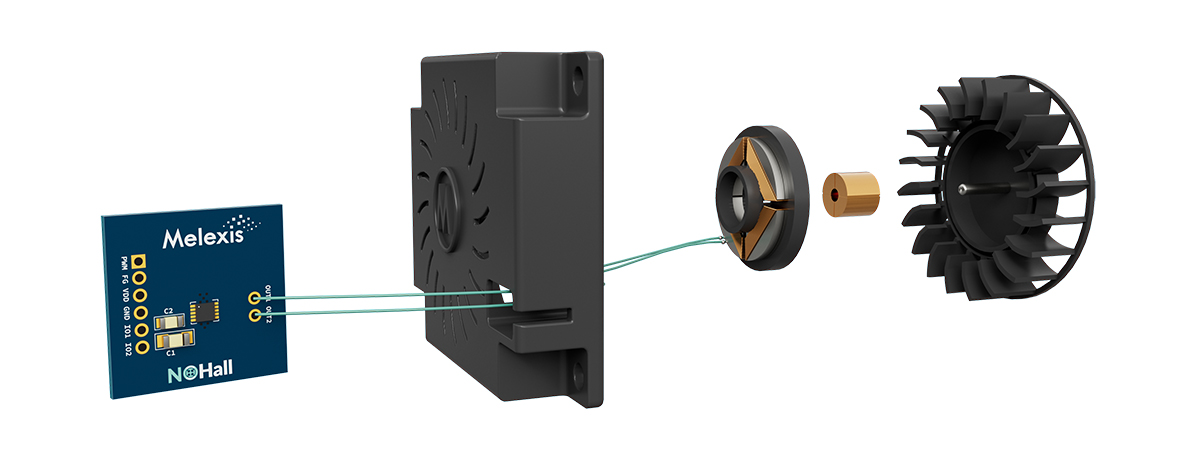
To further decrease the R&D cost and development effort, the MLX90416 and MLX90418 integrate more digital features. These features include flexible transfer curve options with 8x setting points, an I2C interface, bi-directional operation, specific features for server applications (universal wind milling, power loss brake, AC power loss) and many more.
From consumer electronics, over whitegoods & home appliances, to industrial or server applications, this all-in-one solution has broad use cases. Whether it's a fan, blower or pump, the MLX90416-18 are set to power these devices with reduced costs, greater longevity and better performance.
2. What is a Single-Coil BLDC Motor?

A single-coil BLDC motor is a type of brushless motor that only uses a single winding or coil for the stator. Typical designs include an inner stator with a stationary coil winding, and a rotating outer rotor with permanent magnets.
The motor’s operation involves the rotor being attracted and repelled by the interaction of its permanent magnets with the rotating magnetic field in the stator, induced by driving current through the motor coil in different directions.
The stator is intentionally designed with an asymmetric air gap or stator pole, which creates a cogging torque that, once the motor is stopped, holds the rotor in a known cogging position. This allows the controller to ensure the rotor starts up in the correct direction.
The simple single-coil BLDC motor design helps reduce manufacturing complexity while maintaining high efficiency.
2.1. The Advantages of Brushless Motors
Brushless DC motors are often preferred over their brushed DC counterparts in industries where reliability, longevity, and efficiency are essential as they offer several advantages:
- Higher Efficiency: Without brushes to create friction and energy loss, brushless motors convert more power into useful motion and generate less heat.
- Higher Power Density: These motors are more compact and deliver more power relative to their size and weight, which is crucial for space-constrained applications.
- Longer Lifespan and Lower Maintenance: With no brushes to wear out, brushless DC motors last longer and require less maintenance.
- Reduced Electrical Noise: Since there are no brushes, brushless DC motors produce less electrical noise, which is beneficial in sensitive electronics or medical equipment.
2.2. The Single-Coil vs. 3-Phase BLDC Motor Debate
The choice between a single-coil and a 3-phase BLDC motor depends on the specific requirements of the application, but typically comes down to a cost versus performance trade-off.
- Single-Coil BLDC Motors: These are simpler and more cost-effective. They require less complex control circuitry, making them easier to design and less expensive to manufacture.
- 3-Phase BLDC Motors: These deliver higher torque and smoother power output, resulting in quieter operation with less vibration. However, they require more complex control systems and are more expensive.
Single-coil BLDC motors are ideal for low-power applications where cost is a critical factor, while 3-phase motors are better suited for high-power, high-efficiency needs. With the MLX90416 & MLX90418 products Melexis extends the power range for these single-coil BLDC motors by offering an all-in-one, cost-effective, highly efficient solution.
How is a Single-Coil BLDC Motor Controlled?
In a single-coil motor, commutation refers to the moment of reversing the direction of current in the stator coil. By reversing the direction of the current, the generated magnetic field changes polarity and attracts/repels the next rotor’s permanent magnetic pole. To maintain continuous rotation, the controller needs to know the rotor’s position in order to know when to commutate.
Traditionally, Hall sensors have been used in single-coil BLDC motors. The Hall sensor is placed on a small printed circuit board inside the motor module designed to sense the rotor’s magnetic field and provide the feedback necessary for proper commutation. The PCB typically also contains the motor controller, driver and other electronics.
Fitting the PCB inside the motor module adds extra mechanical constraints and design complexity. In fan applications, the rotor and blade design need to be adjusted to fit the PCB. Also placing the Hall sensor close enough to the rotor can be challenging, especially in pump applications with the presence of the fluid.
3.1. Why Choose Sensor-less Control?
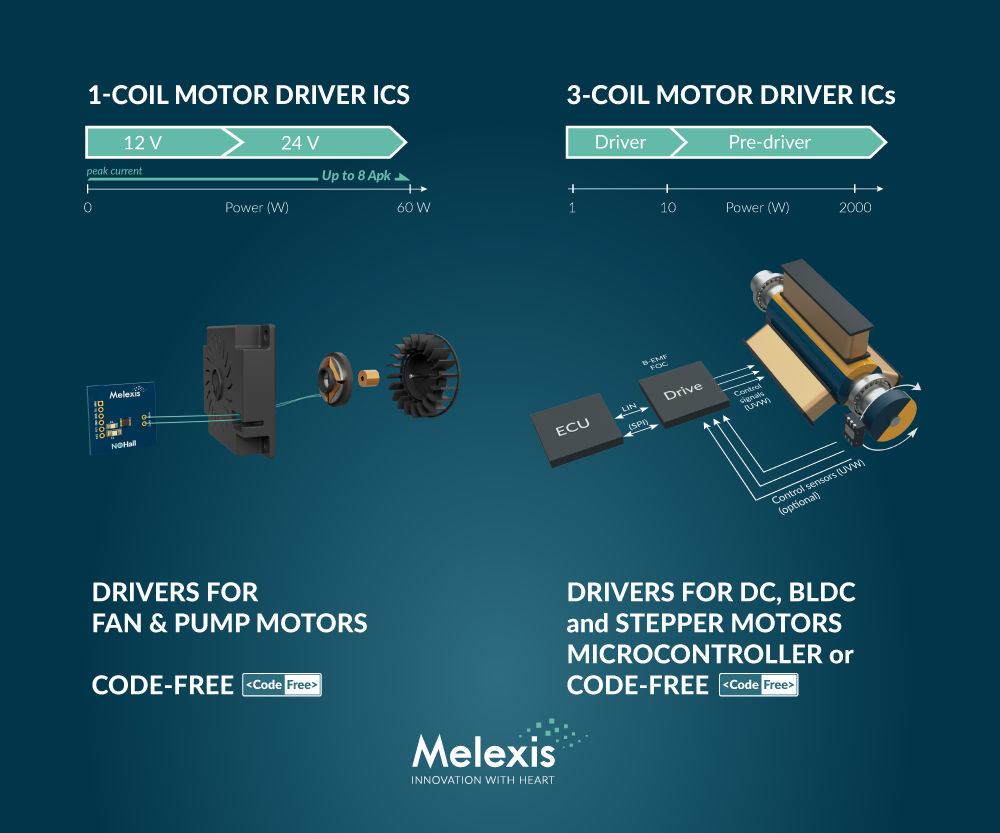
As the name already indicates, the No-Hall product family does away with the need for these Hall effect sensors. Instead, it relies on sophisticated algorithms and signal processing techniques to extract the necessary rotor position information directly from the motor's electrical signals. While this is innovative for single-coil BLDC motors, it is already widespread and accepted in the market for 3-phase BLDC solutions. This seemingly simple change offers a range of benefits for small, single-coil BLDC fans, blowers and pumps:
- Simpler, More Compact Design: The overall MLX90416-18 system integration, with the integration of the sensor-less control and other MCU features, reduces the bill-of-materials and allows for a more compact design. This reduces the number of components, saving on both cost and PCB space.
- Design Flexibility: The sensor-less design allows for more flexibility in placing the electronics away from the motor itself. This allows the fan design to be optimized and simplifies pump system designs.
|
Melexis | Competitor 1-coil BLDC Sensored solution |
MLX90416-18 1-coil BLDC Sensor-less solution |
|
|
Power density (current range, small package, limited BOM) |
+ | ++ |
|
Performance (acoustic/vibration) |
+ | + |
| System design & reuse | + | ++ |
| Reliability & durability | + | ++ |
3.2. Sensor-less Control: A Breakthrough in Motor Control
While there are several advantages to sensor-less 3-phase or 1-coil BLDC motor control, it’s important to acknowledge that sensor-less control algorithms are more complex than those using Hall sensors.
- Starting the Motor: One of the biggest challenges of sensorless BLDC motors is starting the motor. The No-Hall patented motor control IP makes sure the motor can be started in the correct direction, achieving a smooth and reliable start-up.
- Complexity of Control: The No-Hall patented motor control IP provides the needed advanced control circuitry and algorithms required in sensor-less control. Different algorithms are implemented for nominal motor control, as well as for detecting faulty operations like locked rotor detection.
4. What are the Advantages of Externalizing the PCB?
Moving the PCB outside the motor unit can have profound implications: improving the system’s design flexibility, heat management, durability and serviceability. This approach, with PCB-less motor units, is particularly useful in environments where high temperatures, dust, or moisture are present, such as in industrial fans, blowers or pumps.
- Simplified System Design & Reuse: Moving the PCB away from the motor allows for the use of a single PCB across multiple applications, reducing design complexity and cost, while improving time to market. Without the mechanical constraints from having the PCB in the fan design (PCB-less fan), it allows the user to optimize the rotor and blade design.
- Modular Design & Simplified Troubleshooting or Repairs: With the PCB outside, the user can design the system with a modular approach, where different components (motor, PCB) can be in separate locations. This gives more flexibility in how to place the PCB-less motor unit and electronics within the overall system. It also makes it easier to access, repair, or replace the independent parts if they fail, without needing to disassemble the motor unit. This allows for faster repairs, especially important in systems that require minimal downtime.
- Better Heat Management: When the PCB is close to the motor, it can be exposed to high temperatures due to the motor coil's heating or its environment. By placing the PCB outside, the electronics can be exposed to better airflow or be located in a more thermally favourable environment. This helps protect the electronics from overheating, ensuring more reliable performance and increasing the lifespan of sensitive components like the motor driver, controller, and capacitors.
- Protection from Dust and Moisture: Many fans are used in environments where dust, moisture, or debris can accumulate, which could potentially affect the PCB if it is housed inside the fan. By externalizing the PCB, it can be housed in a more protected environment. For example, inside a sealed, dustproof or waterproof enclosure, connector or in a location with better airflow that keeps contaminants away from the components.
- Isolation from Vibration: The motor unit often undergoes vibrations during operation, which could negatively affect the PCB components and solder joints. By positioning the PCB outside, it can be protected from mechanical stress and vibrations that may affect the electronics' reliability.
4.1. Real-World Applications

Several real-life applications can benefit from the advantages of externalizing the PCB and using the MLX90416-18 all-in-one, code-free driver in sensor-less control systems:
- Industrial Fans and Blowers: Industrial environments often have harsh conditions, including high dust, moisture, heat, and vibrations. Having an external PCB allows placing it in a more protected enclosure (or a remote-control box) for better protection against these factors. Furthermore, isolated PCB and motor unit allow for easier maintenance and repair.
- Water Pumps: Many water pumps operate in wet, humid, or corrosive environments where exposure to water or chemicals can damage internal electronics.
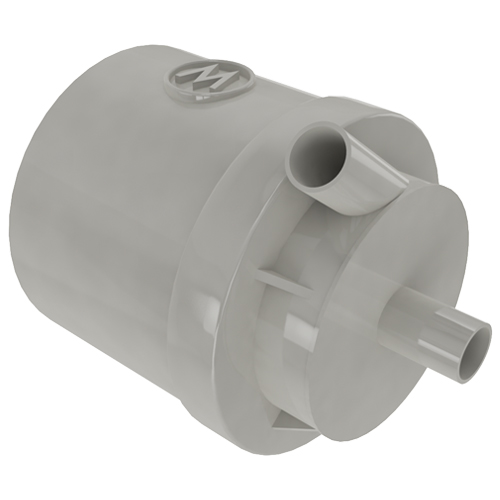 Moving the PCB outside the motor housing (perhaps in a sealed, waterproof enclosure) allows the pump to be submerged, while protecting the electronics without special coatings. This results in increased reliability in applications like pool or aquarium pumps, or industrial water pumps, which need to run smoothly over long periods of time, without maintenance.
 - Consumer Appliances: Small devices like vacuum cleaners and hairdryers benefit from the compact design, feature integration and durability of the MLX90416-18 all-in-one solution. Externalizing the PCB helps improve the appliance’s overall durability by protecting it from dust or heat.
- Exhaust Fans: Whether in kitchens or bathrooms, exhaust fans are often exposed to heat and moisture. Moving the PCB in an external enclosure helps protect the electronics from these conditions while also providing easier serviceability.
- Hot Air Distribution Fans: Fans used to distribute hot air, e.g. in ovens or air fryers, are exposed to high temperatures. External PCB placement allows the electronics to be placed in a more thermally favourable environment, ensuring better heat management, improving durability and longer lifespan.

5. Conclusion
The MLX90416-18 all-in-one, code-free, sensor-less single-coil BLDC driver is a revolutionary solution that combines simplicity, efficiency, and cost-effectiveness for a wide range of applications. By eliminating the need for Hall sensors and offering sensor-less control, it simplifies design, reduces cost and time to market, and improves reliability and durability, all while extending the power range for single-coil BLDC motors. On top, the code-free solution removes the need for any software development, reducing the development effort and cost. This innovation is transforming how we approach motor control in everything from consumer electronics to industrial systems, providing a significant advantage in cost, performance, and sustainability.


