
Melexis Gives Humanoid Robots Sense of Touch with Its First Tactile Fingertip Module
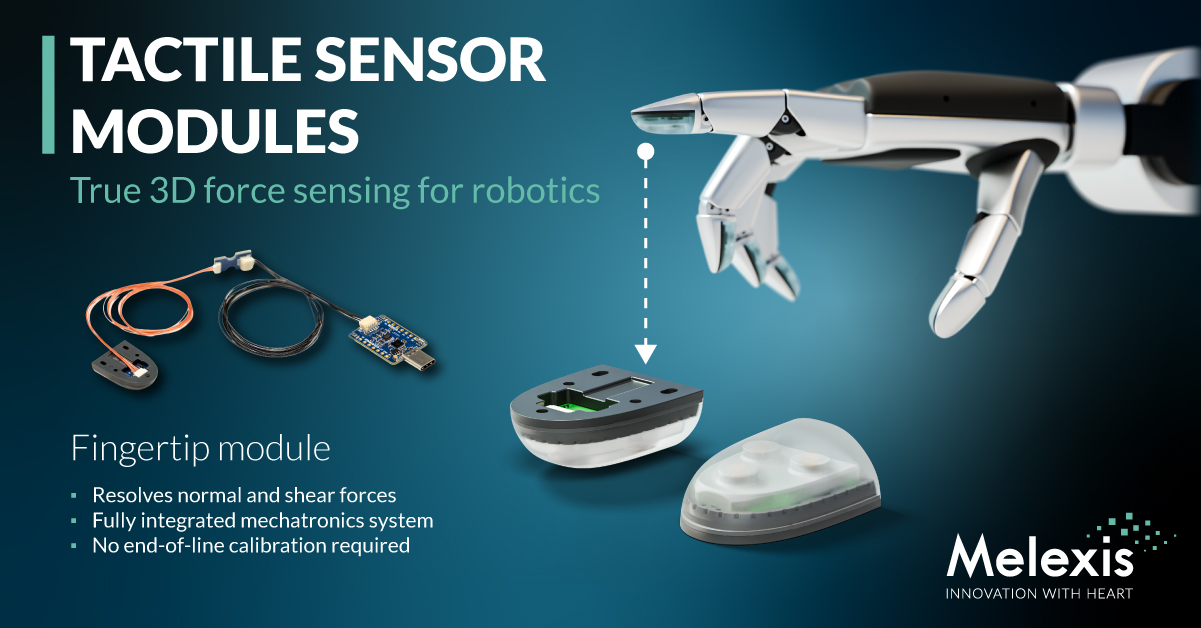
Tessenderlo-Ham, Belgium, 12th November 2026 – Melexis introduces the MLX90901 Tactile Fingertip Module, bringing true 3D force sensing (normal & shear) to humanoid robotic hands. The company’s first mechatronic module combines its revolutionary Tactaxis® sensing technology with the complete mechanical, material, and integration support needed to accelerate tactile sensing evaluation and deployment.
Advances in AI are rapidly improving robots’ ability to interpret instructions, reason about tasks, and plan actions. However, translating those decisions into reliable physical interaction depends on sensory information that many robotic systems still lack. Picking up an unfamiliar object, maintaining a stable grasp as it moves, or manipulating it without damage requires continuous information about the magnitude and direction of contact forces. Tactile feedback will therefore be essential if humanoid robots are to approach human levels of dexterity.
Today, many robots still rely on simple grippers with no tactile feedback or contact-force sensing limited to a single axis. At the other end of the spectrum, advanced multisensory hands remain largely confined to research, where high costs, bespoke sensing architectures, and integration complexity make them difficult to industrialize. No clear winning technology has yet emerged that can meet today’s requirements for sensing performance, ease of integration, and scalability, let alone continue evolving as the humanoid robotics market advances.
Accelerating Physical AI Development
Melexis’ new fingertip module is designed to meet this emerging market need by combining true 3D force sensing with the integration, readiness, and scalability required for humanoid hand development. Rather than measuring only the force perpendicular to the sensing surface, it resolves the contact force across three axes, capturing normal force together with shear in two directions. This provides both the magnitude and direction of the applied force, giving robots a far more complete view of grasp stability, load movement, and the interaction between the fingertip and object.
Built on Melexis’ magnetic Tactaxis® technology, as Melexis’ first module, it combines the sensor, magnet, elastomer, mechanical structure, and supporting electronics within a mechatronic fingertip module. Engineering these interdependent elements as a complete system removes much of the materials, assembly, and sensing complexity that developers would otherwise need to solve themselves.
Instead, the DVK90901 provides hand manufacturers with a standard platform for faster benchmarking, prototyping, and system development, while robot OEMs can quickly begin generating the high-quality contact data needed to develop and validate closed-loop control and physical AI. This creates a practical foundation that can continue to advance as robotic dexterity and market requirements evolve.
From Sensor Technology to Scalable Module
The MLX90901 measures normal forces across a range of 15 N and shear forces across a range of 4 N. It combines 10% full-scale accuracy and a typical resolution of 200 mN, enabling developers to capture small changes in contact force during realistic grasping and manipulation tasks. Support I²C simplifies connection to robotic hand controllers and embedded development platforms.
The launch culminates four years of Tactaxis® maturing. Melexis first demonstrated the underlying biomimetic sensing principle through individual taxels, allowing engineers to evaluate the technology as a concept. Customer trials and application development have provided the system-level insight needed to turn that sensing principle into a standard fingertip module, combining research progress with Melexis’ productization and volume-manufacturing experience.
A new evaluation kit further enables developers to benchmark the MLX90901, characterize its three-axis force response, and begin integrating the module into robotic hand designs. This gives hand manufacturers and robot OEMs a straightforward route to evaluate Tactaxis® against emerging application requirements and collect representative contact data.
Building a Tactile Platform for Humanoid Robotics
“When we began developing Tactaxis®, we could see research into tactile sensing accelerating and recognized how closely it aligned with Melexis’ magnetic sensing expertise,” said Julien Ghaye, Product Line Manager at Melexis. “With the MLX90901, we have gone beyond the sensing element to engineer Melexis’ first complete mechatronic module. Taking responsibility for materials, mechanics, electronics, and integration demonstrates the depth of our commitment to humanoid robotics. We are playing the game to the end, combining research foresight with the industrialization experience needed to deliver something practical today and build towards the scale this market will require.”
The DVK90901 evaluation kit is now available. As the first standard Tactaxis® fingertip module, the MLX90901 provides the foundation that Melexis will build upon as humanoid robotics applications, performance requirements, and production volumes advance.